
Imagine stepping onto a battlefield where minds collide and triumphs are forged through sheer brainpower: welcome to the electrifying realm of sports debates! These contests are far more than casual chats; they are intricate mental duels demanding strategy and deep knowledge. I remember reading a study from the Journal of Argumentation in Education (2017) that showed how well structured debates can hone critical thinking abilities. But how does one construct arguments for sports debates so convincing that they sway your listeners? I have been there, passionately championing a team or athlete, only to be met by a fierce adversary. The real trick is to go beyond mere opinions and build strong, fact supported arguments. Let me arm you with the methods to achieve victory in your next sports debate. This guide will provide you with the arguments for sports debates needed to prevail.
Understanding the Core Elements of Winning Sports Arguments
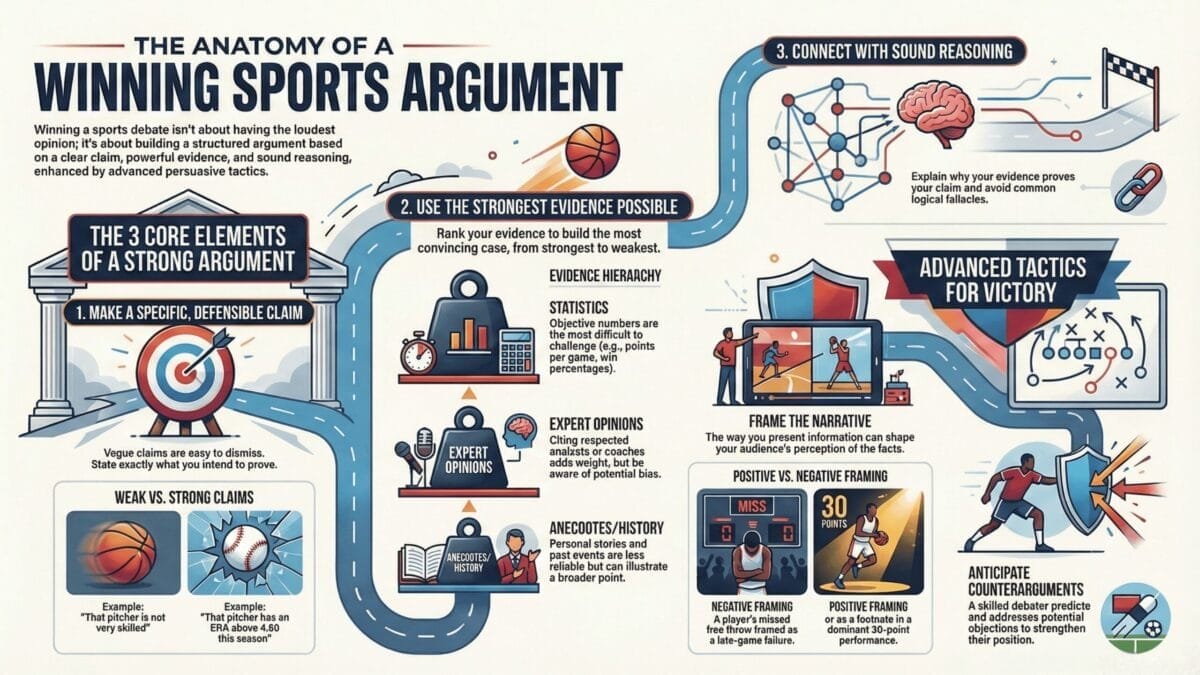
Before we get into sophisticated approaches, understanding the basic pieces of solid argumentation is essential. A convincing argument depends on three vital components:
- Claim: The precise idea you intend to prove.
- Evidence: The data, statistics, instances or professional insights backing up your claim.
- Reasoning: The rational connection linking your evidence to your claim.
If any of these pieces are missing, your argument becomes less effective. Picture declaring Michael Jordan the best basketball player ever (a typical sports debate claim) without offering supporting information or valid reasoning. It stays just an opinion, easily challenged. Let us see how to strengthen each of these pieces.
Developing Clear Claims for Maximum Effect
Unclear or excessively wide claims are hard to defend successfully. Being very specific is crucial. Instead of saying, “Team A is superior to Team B,” try stating, “Team A averages more points each game and has a stronger defensive record than Team B this season.” Exact claims make finding compelling evidence simpler.
Here are some examples:
- Weak Claim: “The Lakers are an excellent team.”
- Strong Claim: “The Lakers have secured more NBA championships than any other team with the exception of the Boston Celtics.”
- Weak Claim: “That pitcher is not very skilled.”
- Strong Claim: “That pitcher has an ERA above 4.50 and a WHIP over 1.40 this season.”
The stronger claims offer more detail and provide a clearer target for your rival. They also make your stance easier to defend.
Finding Powerful Evidence to Back Up Your Points
Evidence acts as the fuel that powers a solid argument. It transforms an opinion to an informed stance. However, the value of evidence varies greatly. Below is a ranking of evidence styles, from strongest to weakest:
- Statistics: Numbers are difficult to challenge. Employ stats to reinforce your claims. Points per game, win percentages, completion rates and similar figures prove invaluable in evidence based arguments.
- Expert Opinions: Referencing respected analysts, coaches or athletes adds weight to your argument. Keep possible biases in mind. A coach might praise their own players, even if statistics suggest otherwise.
- Anecdotal Evidence: Personal stories can persuade, but statistics or expert opinions are stronger. Use anecdotes sparingly to illustrate a larger idea, not as your primary support.
- Historical Data: Past actions can suggest future results. Still, remember that history may not repeat. Athlete injuries, coaching changes and unexpected things can radically alter the scene.
Always cite your sources when introducing evidence. This improves your trustworthiness and enables fact checking.
Logical Reasoning: Connecting Your Claim and Evidence
Reasoning serves as the bridge connecting your claim and your evidence. It explains why your evidence backs up your claim. Absent solid reasoning, your argument falls apart.
Below are common types of reasoning used in sports debates:
- Deductive Reasoning: Begin with a general rule and use it for a specific situation. Example: “All NFL quarterbacks are professional athletes. Patrick Mahomes is an NFL quarterback. Therefore, Patrick Mahomes is a professional athlete.”
- Inductive Reasoning: Start with specific details and reach a general conclusion. Example: “Team Y has won its previous six games. Their offense scores easily and their defense shuts down rivals. Therefore, Team Y will likely win its next game.”
- Causal Reasoning: Argue cause and effect. Example: “The team started a new training program focused on injury prevention. Consequently, the team has seen fewer injuries this season.”
- Analogical Reasoning: Compare similar scenarios to argue a point. Example: “Player B thrived in a similar offensive scheme with his previous team. Therefore, Player B will probably thrive in this team’s system, too.”
Regardless of the reasoning you use, ensure your logic is sound and your connections are understandable. Avoid common logical mistakes such as:
- Ad Hominem: Criticizing the person giving the argument instead of the argument itself.
- Straw Man: Distorting your rival’s argument making it simpler to attack.
- False Dilemma: Showing only two options when more exist.
- Bandwagon Fallacy: Claiming something is correct because many people think it is.
Sophisticated Methods for Convincing Arguments
Once you understand the basics of argumentation, you can use more sophisticated persuasive debate techniques to improve your abilities.
Framing the Story
Presentation proves as important as the argument. Framing shapes the story, stressing certain details while minimizing others. When talking about an athlete’s performance, you might frame it by emphasizing their general impact on the team or by highlighting specific individual stats. You choose, and that can really change perception.
Here are framing examples:
- Scenario: A basketball player missed a critical free throw in the last seconds of a game.
- Positive Framing: “Even with the missed free throw, the athlete scored 30 points and grabbed 15 rebounds, displaying their total dominance in the game.”
- Negative Framing: “The missed free throw lost the game for the team, emphasizing the athlete’s failure to perform when it mattered most.”
Predicting and Handling Counterarguments
A skilled debater not only presents their own arguments but also predicts and handles likely counterarguments. This shows a deeper grasp of the subject and strengthens your overall position. Before starting a debate, think about potential objections and prepare your responses. This will make your argument stronger.
If you argue that a team will win the championship, handle worries about their weak defense or athletes prone to injuries. Then, give evidence and rational reasoning to dispel those worries.
The Strength of Rhetoric
Rhetoric involves the art of effective and convincing speaking or writing. Learning rhetorical devices helps you connect with your audience and sway their thinking.
Some common rhetorical devices include:
- Metaphors and Similes: Using figurative language to create strong images and boost understanding.
- Analogy: Connecting your subject to familiar ideas to make it more accessible.
- Repetition: Repeating important words or concepts to add emphasis.
- Rhetorical Questions: Asking questions that provoke thought and involve your listeners.
Use rhetorical devices carefully to avoid coming across as overly dramatic. Honesty builds trust and credibility.
Sports Debate Examples and Potential Arguments
To show these ideas, let us examine common sports debate subjects and potential arguments.
Topic 1: Who is the Best Quarterback Ever? (Tom Brady versus Patrick Mahomes)
- Argument for Tom Brady: “Tom Brady’s seven Super Bowl wins, five Super Bowl MVP awards and numerous passing records solidify his standing as the greatest. According to Pro Football Reference.com, Brady holds the NFL record for career passing yards and touchdown passes. His consistent success across two decades shows unmatched skill and durability.”
- Potential Counterargument: “Patrick Mahomes is changing the game with his amazing arm strength and improvisational skills. His two Super Bowl wins and two MVP awards at a young age suggest he will surpass Brady’s achievements.”
Topic 2: Should College Athletes Receive Pay?
- Argument for Paying College Athletes: “College athletes generate billions of dollars for their schools, yet they only get scholarships. The NCAA’s rules on athlete pay are exploitative and unfair. Paying athletes would enable them to cover their living costs and provide financial security for their families. Many arguments for sports debates focus on the ethics of amateurism.”
- Potential Counterargument: “Paying college athletes would create a professional system undermining the schools’ educational goals. Also, determining fair pay for athletes across different sports and levels of competition would prove hard.”

Vince Douglas Gregory is the ‘petulant puppet master’ of a sports media landscape addicted to scripted rage and performance art. As the architect of VDG Sports, he bypasses the corporate talking heads to expose the unfiltered truth behind the narratives.
An unstable thinker and astute scholar, Vince thrives on dismantling the mediocre click-bait addicts who trade reality for engagement. If you want boring stats, go elsewhere. If you want the raw reality of the game, you’re in the right place. Consider yourself warned.