
Did you know that a staggering 70% of communication happens without a single word? That is something I have seen lost in translation so many times, especially when you toss cultural differences into the mix during cross-cultural sports debates. A study from the Proceedings of the National Academy of Sciences in 2024 really hit this point home. Winning an argument is not just about having the best points; it is about understanding what is not being said, especially when people from different backgrounds get together. I have personally seen how these cultural details can make or break discussions.
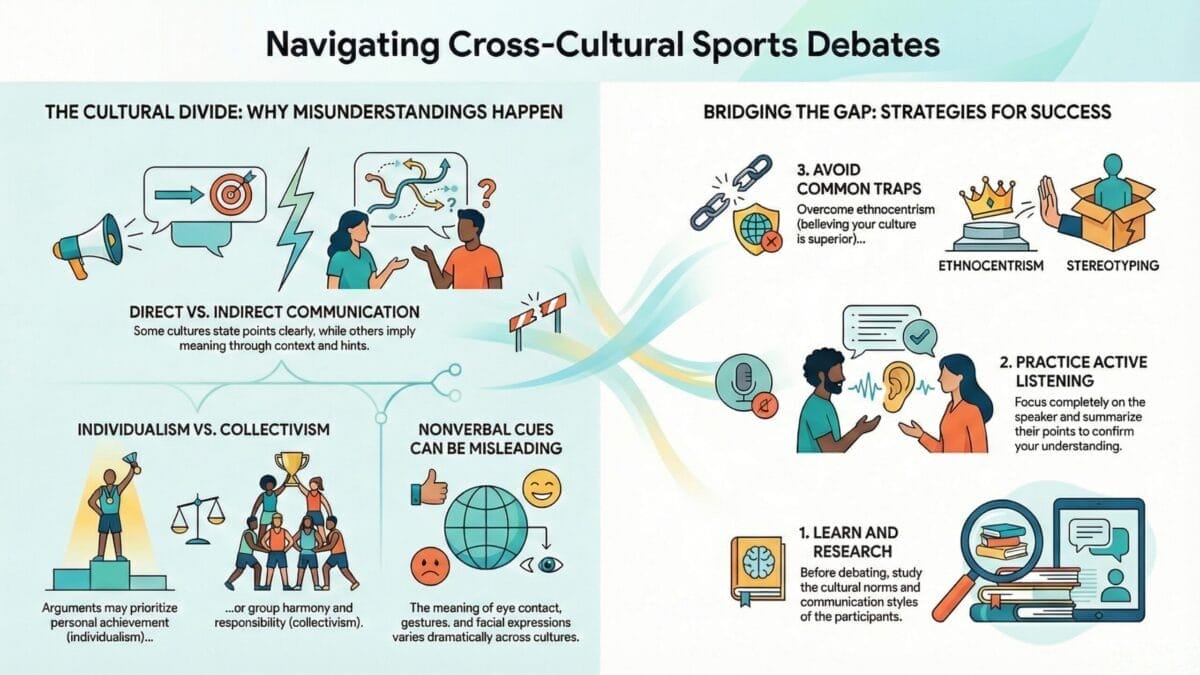
My team has spent years taking apart international discussions. We watch how people communicate and look for the usual problems. I want to share some advice on how to handle these tricky cross-cultural sports debates. The goal is to help you build stronger relationships all over the world.
International Sports Discussions: The Details
Sports are global. They bring together people from every country. When these people talk, whether they are coaches, athletes or fans, cultural differences are unavoidable. These differences show up in how people make arguments and how much emotion they show.
For example, some cultures prefer clear and direct talk, while others are more subtle. If you do not recognize these differences, you can end up confused or misunderstood, and discussions will go nowhere. I have seen people from cultures that value community struggle to understand those from cultures that value independence. This leads to frustration and dead ends.
Why Cultural Sensitivity Matters in Sports Discussions
Cultural sensitivity is a must if you want to communicate well around the world. You must recognize and appreciate the beliefs, values and traditions of different cultures. That does not mean you have to give up your own culture; it simply means you are open to other viewpoints. When you take part in international discussions, this awareness can bridge gaps.
I recall a discussion when a joke that seemed harmless caused great offense. The discussion quickly turned into a heated argument, which showed just how important cultural awareness is. A simple apology and an acknowledgment of the misunderstanding could have kept the situation from getting out of hand.
Important Points of Cultural Communication in Cross-Cultural Sports Debates
To really take part in cross-cultural sports debates, you have to think about some key parts of cultural communication. These points affect how messages are sent, received and understood.
- Communication Styles: Direct versus Indirect
- Nonverbal Communication: Facial Expressions and Body Language
- Values and Beliefs: Collectivism versus Individualism
- Context: High Context versus Low Context Cultures
- Emotional Expression: Open versus Restrained
Let us take a closer look at each of these points to understand how they affect international discussions.
Communication Styles: Direct Versus Indirect
Communication styles can change a lot from culture to culture. Some cultures like direct communication where messages are clear, while others prefer indirect communication where messages are implied. Spotting these differences is key to avoiding misunderstandings.
In cultures that value direct communication, like many Western countries, arguments are laid out in a clear and concise way. The focus is on getting information across in an efficient manner. Someone from a culture that is direct might see someone from a culture that is indirect as vague.
Cultures that value indirect communication, common in many Asian and Latin American countries, focus on context and nonverbal signals. Messages are sent through hints and storytelling. Someone from a culture that is indirect might think that a direct communicator is rude.
Example: Think about a discussion about the ethics of performanceenhancing drugs. Someone from a culture that values direct communication might say, “Using performanceenhancing drugs is cheating and is not acceptable.” Someone from a culture that values indirect communication might express the same point by saying, “We all want to be the best, but we must think about fair play.” The core message is the same, but the delivery is quite different.
Nonverbal Communication: Facial Expressions and Body Language
Nonverbal communication, like facial expressions and body language, is very important in sending meaning. The meaning of these signals can differ greatly across cultures. Something considered polite in one culture might be seen as offensive in another.
For example, eye contact is a sign of sincerity in Western cultures. In some Asian cultures, too much eye contact can be seen as rude. Also, nodding usually means agreement, but in some places, it can mean disagreement.
I recall when someone from the United States was seen as arrogant by a judge from Japan because he kept eye contact and used big gestures. The judge said later that he found the person offputting, despite his arguments. This shows the importance of being aware of nonverbal cues and changing your actions to fit the situation.
Values and Beliefs: Collectivism Versus Individualism
Cultural values and beliefs have a big effect on how people see the world. One of the clearest cultural differences is collectivism versus individualism. Cultures that are individualistic focus on personal success. Cultures that are collectivist focus on group harmony.
In individualistic cultures, like the United States and the United Kingdom, people are told to share their own opinions. Arguments often focus on individual rights. Someone from an individualistic culture might focus on the personal benefits of a plan.
Cultures that are collectivist, like China and Japan, put a greater focus on the needs of the group. People are expected to follow social rules and value the community. Arguments often focus on community responsibility. Someone from a collectivist culture might talk about how a plan affects the community.
Example: In a discussion about funding for youth sports, someone from an individualistic culture might say that funding should be based on individual talent. Someone from a collectivist culture might say that funding should be equal so everyone can take part.
Context: High Context Versus Low Context Cultures
The amount of context used in communication changes across cultures. Cultures that are high context depend on shared history and unspoken understanding. Cultures that are low context depend more on clear language.
In cultures that are high context, like Korea and Japan, much of the meaning is sent through nonverbal cues like tone of voice. Speakers often assume the audience understands the topic and do not say things that are obvious. Someone from a culture that is high context might use stories to make their points.
Cultures that are low context, like the United States and Germany, put more focus on articulation. Speakers are expected to give all the facts. Someone from a culture that is low context might use data to support their arguments.
Example: In a discussion about the government’s part in sports, someone from a culture that is high context might talk about cultural norms to support their position. Someone from a culture that is low context might cite laws to back up their arguments.
Emotional Expression: Open Versus Restrained
How emotions are expressed also changes across cultures. Some cultures are open to emotional expression. Others value emotional control. Recognizing these differences is important for respectful communication.
In cultures that value open emotional expression, like Brazil and Italy, people show their emotions freely. Emotions are seen as normal and not a sign of weakness. Someone from a culture with open emotional expression might use passionate language.
Cultures that value emotional restraint, like Finland and Japan, stress the importance of controlling emotions. Displays of emotion are seen as unprofessional. Someone from a culture valuing emotional restraint might speak calmly.
I once saw a debate where someone from Lebanon got angry and raised their voice. While this might have been normal in their culture, others saw it as disrespectful. This shows how important it is to know about cultural norms.
How to Change Your Debate Approach in Cross-Cultural Sports Debates
Changing your debate approach to fit cultural differences is key for communication around the world. Here are some approaches that can help you handle these details:
- Learn and Research: Before a debate, learn about the cultural norms of the people involved.
- Watch and Listen: Pay attention to how others communicate and try to understand them.
- Be Aware of Nonverbal Signals: Be aware of your own facial expressions and try to understand those of others.
- Ask Questions: If unsure, ask.
- Be Open Minded and Respectful: Be willing to learn and be respectful.
- Practice Active Listening: Be sure you understand before you speak.
Learn and Research: The Power of Getting Ready
Getting ready is key in any debate, but it is specifically important in international settings. Before a debate, learn about the cultural norms of the people involved. This includes how they communicate, their values, and their attitudes about emotions.
Many resources can help you learn about different cultures, including books, articles, websites and training programs. You can also talk to people from different cultures to get their ideas. The more you know, the better you can communicate.
I often tell my team to read about the social customs of the countries they will be in contact with. This helps them better understand and avoid mistakes.
Watch and Listen: Tuning In
Paying attention to how others communicate is key to changing your debate approach. Watch how people express themselves, both in what they say and how they say it. Notice their tone of voice and their body language. Listen to their word choice and how they build their arguments.
By watching and listening, you can understand the cultural norms that affect communication. This will let you change how you communicate to be more respectful. It is easy to misread a gesture if you are not paying attention.
Be Aware of Nonverbal Signals: Actions Matter
Nonverbal signals can be as important as what you say, specifically in international settings. Be aware of your own facial expressions and try to understand those of others. Remember that nonverbal signals can change a lot across cultures. What is polite in one culture might be offensive in another.
For example, keeping eye contact is often seen as a sign of attention in Western cultures. In some Asian cultures, too much eye contact can be seen as rude. Similarly, nodding can mean agreement, but in some places it can mean disagreement.
I once worked with people who were getting ready to meet with people from the Middle East. I told them not to cross their legs, as this is seen as rude in that culture. This helped them build a good relationship.
Ask Questions: When in Doubt, Ask
If you are not sure about something, ask. It is better to ask and risk seeming uninformed than to assume and risk offending someone. Asking shows that you are paying attention and want to understand.
When asking, be sure you are respectful. Do not use accusatory language. Instead, focus on seeking understanding.
Example: “I am not sure I understand. Could you explain more?” or “I am not familiar with that idea. Can you give me some context?”
Be Open Minded and Respectful: Value Difference
Being willing to learn and being openminded is key for communication around the world. Remember that people from different cultures may have different beliefs. Be respectful of these differences and avoid making judgments.
Instead of trying to force your own cultural norms on others, try to understand them. Listen and be willing to think about other ideas. By valuing difference, you can create a better experience for everyone.
I always tell my team to see international interactions as a chance to grow. By working with people from different backgrounds, we can grow and better understand the world.
Practice Active Listening: Listen Intently
Active listening is when you pay close attention to what the other person is saying, both in words and body language, and then give feedback to be sure you understand. This helps in international settings where misunderstandings are more likely.
To do active listening, focus your attention on the speaker and do away with distractions. Make eye contact and nod to show you are paying attention. Then listen to the speaker’s words and try to understand their main point. Once the speaker is done, sum up their points and ask if you have understood correctly.
Example: “So, if I understand you, are you saying…?” or “Are you suggesting…?”
Usual Problems in International Sports Debates
Even with careful planning, some problems can get in the way of communication around the world in sports discussions. Knowing these problems is the first step in stopping them.
- Ethnocentrism
- Stereotyping
- Language Barriers
- Misinterpretations of Nonverbal Signals
- Assumptions of Similarity
Ethnocentrism: The Risk of Cultural Superiority
Ethnocentrism is thinking that your own culture is better than others. This can lead to bad judgments and a failure to understand other ideas. In sports discussions, ethnocentrism can show up as a dismissive attitude toward other perspectives.
To avoid ethnocentrism, you must know that all cultures have their own good and bad points. Instead of judging other cultures based on your own values, try to understand them from their point of view. Be willing to learn and challenge your own ideas.
Stereotyping: The Risk of Making Generalizations
Stereotyping means making generalizations about entire groups of people based on limited information. This can lead to unfair judgments and a failure to appreciate differences. In sports discussions, stereotyping can show up as assumptions about the talents of athletes from certain countries.
To avoid stereotyping, you must remember that every person is unique. Avoid making assumptions based on someone’s background. Instead, treat each person as an individual and get to know them.
Language Barriers: The Communication Challenge
Language barriers can be a big problem in sports discussions around the world. Even if all people speak the same language, differences in words can cause misunderstandings. When people speak different languages, it is even harder.
To get past language barriers, you must communicate simply. Avoid using slang. Speak slowly and clearly. If possible, use pictures. When talking with someone who speaks a different language, use a translator.
Misinterpretations of Nonverbal Signals: Decoding Silent Signals
As I have said, nonverbal signals can change across cultures. Misreading these signals can cause problems. For example, a smile might be friendly in one culture but insincere in another.
To avoid misreading nonverbal signals, you must be aware of cultural differences and pay attention to the context. If you are unsure, ask.
Assumptions of Similarity: The Trap
Assuming that people from different cultures are like you can be a trap. While there may be some common ground, cultural differences can affect behavior. Assuming others share your beliefs can cause conflict.
To avoid making assumptions, you must be curious about other cultures. Ask questions and be willing to challenge your own ideas. By valuing difference, you can build relationships and communicate better.
Communication Across Cultures in Sports: The Future
As the world becomes more connected, communication around the world will become more important in sports. Fans, coaches and athletes will keep talking, both on and off the field. Those who can handle these details will be better off.
I expect to see more focus on cultural education in sports organizations. Athletes will learn how to communicate with people from different cultures, and fans will be told to be respectful of differences. Technology will also have a part. Virtual reality and translation apps will help with communication.
In the end, the key to doing well in sports discussions around the world is to adapt, learn and value difference. By respecting differences, we can create a better place for everyone.
By understanding the details of cultural communication, people in international discussions can build understanding. Avoiding stereotypes and assumptions is a must. This leads to exchanges that are more productive and enriches the global sports world. Mastering cross-cultural sports debates is more and more important in our connected world.

Vince Douglas Gregory is the ‘petulant puppet master’ of a sports media landscape addicted to scripted rage and performance art. As the architect of VDG Sports, he bypasses the corporate talking heads to expose the unfiltered truth behind the narratives.
An unstable thinker and astute scholar, Vince thrives on dismantling the mediocre click-bait addicts who trade reality for engagement. If you want boring stats, go elsewhere. If you want the raw reality of the game, you’re in the right place. Consider yourself warned.