
Stop Blaming Coaches: The Real Problem With NFL Offensive Strategy
Another losing season, another offensive coordinator fired. The pattern repeats itself with such predictability that you could set your calendar by it. Yet here’s the uncomfortable truth that nobody in sports media wants to address: firing coaches has become the convenient band-aid that organizations slap over wounds that run far deeper than playcalling on Sunday afternoon.
Every January, as teams begin their now-familiar ritual of clearing out coaching staffs, the narrative machine cranks into gear. The plays were too conservative. The scheme didn’t fit the personnel. The coordinator couldn’t adjust to the team’s offensive struggles. And sure, sometimes those criticisms hit their mark. But they also conveniently ignore the fundamental question that should precede every coaching firing: was this coach ever positioned to succeed in the first place?
The uncomfortable reality is that we’ve created a sports culture that treats coaching changes like magic wands—wave the wand, bring in a new name, and suddenly the offense will hum. It’s comforting to believe that simple solutions exist for complex problems. It’s also dangerously misguided.
The Scapegoat Cycle: How Organizations Avoid Accountability
Picture the typical organizational response when an offense sputters through a disappointing season. The general manager holds a press conference, expressing disappointment in the results while affirming confidence in the overall direction. The offensive coordinator—or sometimes the entire coaching staff—gets shown the door. The front office promises renewed commitment to building a winner. Fans feel momentarily hopeful. And absolutely nothing about the underlying dysfunction changes.
This cycle serves a purpose, just not the one organizations claim. By making coaching changes the focal point of their offseason moves, front offices redirect attention away from their own decision-making failures. When you’re busy debating whether the new offensive coordinator prefers zone or gap blocking schemes, you’re not asking why the roster lacks the talent to execute either effectively.
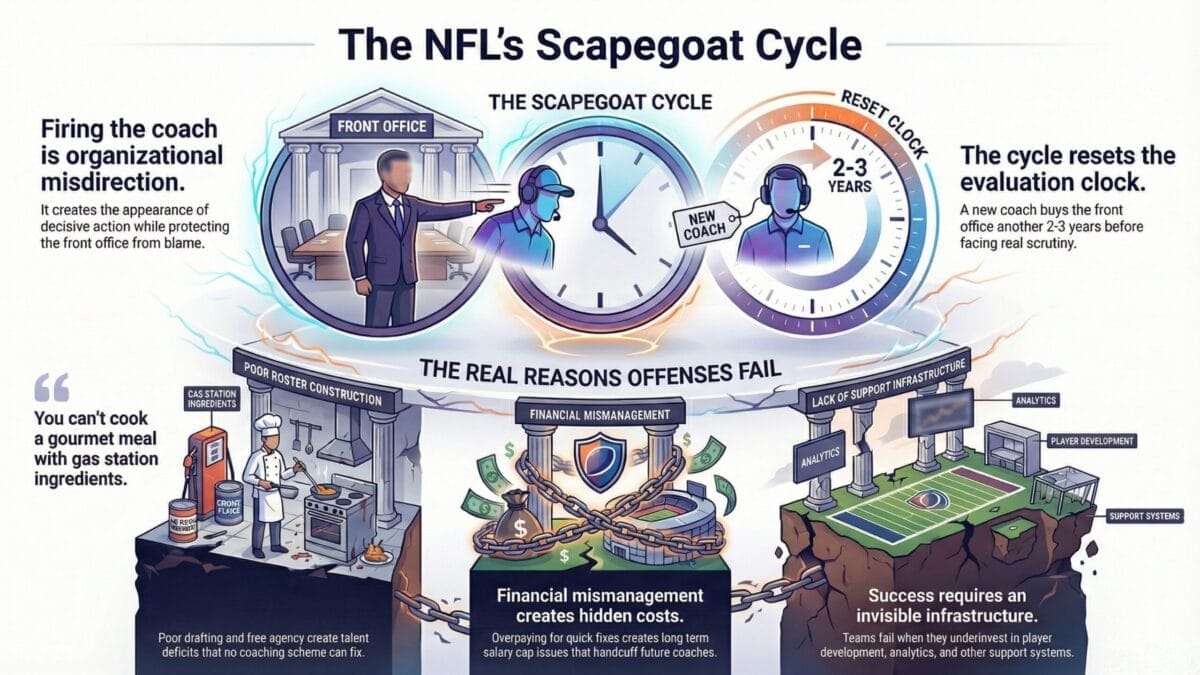
The coaching scapegoat serves as organizational misdirection. It creates the appearance of decisive action while preserving the very power structures that created the problems. General managers protect their positions by sacrificing coaches. Owners avoid scrutiny by letting general managers handle the public-facing accountability. And the media plays along because coaching drama generates clicks and controversy.
The pattern becomes self-perpetuating. Each coaching change resets the evaluation clock, buying front offices another two or three seasons before meaningful questions emerge. By the time the new coaching staff inevitably struggles with the same roster limitations thatdoomed their predecessors, the organization simply restarts the cycle. Different faces, same systemic failures, identical results.
Roster Construction: The Foundation Nobody Wants to Examine
Imagine asking a chef to prepare a gourmet meal, then handing them ingredients from a gas station convenience store. No matter how skilled that chef might be, the fundamental limitation isn’t culinary technique—it’s the raw materials. Yet this exact scenario plays out across NFL front offices every season, with coaching staffs expected to conjure offensive success from rosters that lack the essential building blocks.
The draft represents the most visible failure point in roster construction. When general managers miss repeatedly on premium picks, they don’t just waste opportunities—they create talent deficits that compound across multiple seasons. Those missed first-round offensive linemen mean quarterbacks face constant pressure. Those overdrafted skill players who never develop leave coordinators without the weapons their schemes require. Each personnel mistake creates constraints that no amount of brilliant playcalling can overcome.
But draft failures alone don’t capture the full scope of roster construction dysfunction. The free agency approach matters just as much in building a competitive team in the passing game. Some organizations treat free agency like a fantasy football draft, chasing big names without considering scheme fit or locker room dynamics. Others adopt such conservative approaches that they never address critical needs. Both extremes leave coaching staffs trying to implement strategies with personnel that simply cannot execute them.
Consider the offensive line, often treated as an afterthought in roster construction despite being foundational to every offensive concept. Organizations that neglect investing premium resources in line talent create an impossible situation for their coaches. No quarterback can succeed under constant pressure. No running game can develop without push up front. No scheme adjustments matter when the most basic blocking assignments fail. Yet when the offense struggles, it’s the coordinator who answers for it.
The Salary Cap Shell Game and Its Hidden Costs
Financial mismanagement might be the least discussed yet most destructive organizational failure affecting offensive performance. The salary cap creates a zero-sum environment where every dollar committed to one player, such as a qb, reduces flexibility elsewhere in the formation. When front offices badly miscalculate player value or desperately chase quick fixes through expensive free agent acquisitions, they create long-term constraints that handcuff coaching staffs for years.
The cycle typically begins with a panic move. The offense underperforms, public pressure mounts, and the front office decides they’re “one player away” from contention. They break the bank for a veteran free agent, convincing themselves that this addition will transform everything. What actually happens is they create a salary cap albatross that limits every subsequent roster decision for the next three or four seasons.
These financial mistakes cascade through the roster in predictable ways. The big-money addition doesn’t pan out as hoped. But the organization can’t admit the mistake without taking a massive salary cap hit, so they keep the player despite diminishing returns. Meanwhile, promising young talent developed by the coaching staff becomes too expensive to retain. Quality depth players leave for better offers elsewhere. The supporting cast around those few premium players gradually deteriorates.
Coaching staffs then face an impossible strategic challenge: build an offense around expensive players who may no longer deserve their roster spots, while lacking the supporting talent to implement coherent schemes. When the inevitable struggles follow, who takes the blame? Not the general manager who created the financial mess. Not the owner who approved the spending spree. The coordinator gets fired for failing to succeed within constraints that made success nearly impossible.
Player Development: The Infrastructure Nobody Sees
Behind every successful offense runs an extensive player development infrastructure that remains largely invisible to fans and media. Position coaches who provide detailed technical instruction. Quality control staff who break down film and prepare game plans. Training staff who keep players healthy and optimize performance. Strength and conditioning programs that prepare bodies for the physical demands of the game. When organizations underinvest in this infrastructure, coaching staffs work with one hand tied behind their backs.
The development pipeline matters especially for young players who arrive in the league with raw talent but incomplete skill sets. These players need systematic, professional instruction to reach their potential. They need position coaches who understand not just what to do, but how to teach it effectively. They need support systems that address technical, mental, and physical development simultaneously.
Some organizations build robust development infrastructures that maximize the potential of every player on the roster. Others operate on minimal staffing, asking coordinators to handle game planning, in-game adjustments, and individual player development simultaneously. The difference in results compounds over time. Well-supported staffs gradually elevate their entire roster’s performance. Understaffed organizations watch players stagnate or regress, then blame the coaching for failing to develop talent.
Technology and analytics resources further separate organizations that genuinely support coaching staffs from those paying lip service to winning, particularly in the passing game. Modern offensive coordination requires sophisticated film study capabilities, statistical analysis tools, and communication systems to maximize every touchdown opportunity. Coordinators need resources to identify defensive tendencies, evaluate their own scheme effectiveness, and communicate adjustments efficiently. When organizations underinvest in these essential tools, they create yet another handicap that dooms coaches to suboptimal results.
Organizational Culture: The Invisible Hand Shaping Everything
Perhaps the most powerful yet least acknowledged factor affecting offensive performance is organizational culture. This encompasses everything from how decisions get made to how information flows between departments to whether learning from failure is encouraged or punished. Dysfunctional organizational cultures create environments where even talented coaches cannot succeed, regardless of their scheme knowledge or motivational abilities.
Consider the decision-making structure. In healthy organizations, coaches provide input on personnel decisions because they understand what their schemes require. They collaborate with scouts and general managers to identify prospects who fit their systems. When draft day arrives, everyone’s pulling in the same direction because they’ve built consensus through ongoing dialogue.
Dysfunctional organizations operate differently. The front office makes personnel decisions in isolation, sometimes explicitly overruling coaching input. Draft picks arrive at training camp, and coaches learn they’re expected to incorporate players who don’t fit their schemes or fill their actual needs. When those players inevitably struggle, both the front office and coaching staff point fingers at each other, creating toxic blame cycles that poison the entire building.
Communication breakdowns between departments amplify these problems. Scouting departments develop reports on college prospects using evaluation criteria that don’t align with what the coaching staff actually needs. The medical staff and coaching staff disagree about injury management and player availability. The analytics department produces reports that coordinators find irrelevant to practical game-planning needs. Each breakdown creates friction, wastes resources, and undermines the unified approach required for sustained offensive success.
The Evolution Problem: When Organizations Resist Adaptation
Offensive philosophy in professional football evolves constantly, driven by rule changes, defensive adaptations, and creative scheme innovations. Successful organizations embrace this evolution, remaining flexible and willing to adapt their approaches. Others cling to outdated philosophies, convinced that their traditional methods will eventually prevail if only executed properly. When coordinators arrive ready to implement modern concepts, they discover organizational resistance rooted in nostalgia rather than strategic analysis.
This resistance often stems from ownership or upper management whose football education occurred decades ago. They remember when a certain style of play dominated the league, and they assume those principles remain eternally valid. They hire coaches who promise to implement “their” philosophy, then constrain those coaches from making necessary adjustments when circumstances demand evolution.

The disconnect creates impossible situations for coordinators. They recognize that modern defensive structures require specific offensive responses. They understand how rule changes favor certain strategic approaches. They see clearly what needs to change. But organizational resistance prevents necessary adaptations. When the offense struggles against contemporary defenses, the coordinator takes the blame for failing to succeed with an approach that was already obsolete when they inherited it.
Even organizations that accept evolution in theory often resist in practice. They’ll express support for innovative concepts during the interview process, then gradually impose restrictions once the season begins. Play selection gets questioned. Risk-taking becomes controversial. Every deviation from conservative approaches draws criticism. Coordinators find themselves coaching not to lose rather than coaching to win, knowing that aggressive failures attract more scrutiny than conservative mediocrity.
The Media’s Role in Perpetuating Shallow Analysis
Sports media bears significant responsibility for perpetuating the coaching scapegoat culture. The incentive structure of modern sports coverage rewards hot takes and controversy over nuanced analysis. It’s faster and easier to blame the coordinator for a failed fourth-down attempt than to examine the three years of roster mismanagement that made that fourth-down attempt necessary in the first place.
This shallow analysis shapes public perception in powerful ways. Fans consume countless hours of commentary focused on playcalling decisions and scheme choices. They hear remarkably little about organizational dysfunction, front office accountability, or systemic issues. The resulting narrative imbalance makes coaching changes feel like the obvious solution because those are the problems everyone’s discussing.
The cycle feeds itself. Media focuses on coaching because it’s accessible and controversial. Fan discussion mirrors media coverage. Organizations respond to fan pressure shaped by media narratives. Everyone stays focused on the most visible layer of a much deeper problem.
Breaking this cycle requires a fundamental shift in how we evaluate offensive performance. Instead of immediately questioning playcalling when drives stall, we need to ask whether the players on the field possess the skills to execute any strategy effectively. Before condemning scheme choices, we should examine whether organizational support systems give coordinators the tools and resources they need. Rather than treating coaching changes as self-evident solutions, we must demand accountability from the front offices and ownership groups whose decisions create the conditions for success or failure.
What Real Accountability Looks Like
Genuine organizational accountability requires examining every layer of decision-making that affects offensive performance. It means front offices acknowledging draft failures and adjusting scouting processes. It requires ownership groups investing in infrastructure rather than assuming coaching magic can overcome resource limitations. It demands cultural changes that prioritize collaboration over turf protection and learning over blame.
When an offense consistently underperforms, the first questions should focus upstream from the coaching staff. How does our draft success rate compare to league averages? Are we providing competitive resources for player development? Does our salary cap management create sustainable roster construction? Do coaches have meaningful input in personnel decisions? Is our organizational culture fostering collaboration or breeding dysfunction?
Only after honestly addressing these systemic questions does it make sense to evaluate coaching performance. And even then, the evaluation should account for the constraints under which coaches operated. Did this coordinator have the personnel to execute their preferred schemes? Were they given adequate support resources? Did organizational dysfunction create impossible situations? Fair evaluation considers context, not just results.
Some coaches genuinely do fail and deserve replacement. But those legitimate coaching failures occur far less frequently than the current firing rate suggests. More often, we’re watching organizations scapegoat coaches for problems those coaches inherited and lacked the organizational support to overcome.
The Questions We Should Be Asking
The next time your team’s offense struggles and the inevitable coaching change rumors begin circulating, resist the temptation to join the chorus calling for heads to roll. Instead, push for deeper examination of the real issues. Has the front office consistently hit on draft picks? Are they making sound salary cap decisions? Does the organization invest adequately in player development infrastructure? Is there genuine collaboration between coaching and personnel departments?
These questions feel less satisfying than demanding a coordinator’s firing because they don’t offer simple solutions. Fixing organizational dysfunction requires sustained effort across multiple offseasons. It demands ownership accountability that rarely materializes in professional sports. It’s complicated, uncomfortable, and slow.
But it’s also the only path toward sustainable offensive success. Organizations that address root causes build consistent winners. Those that chase coaching magic endure endless cycles of disappointment punctuated by brief moments of false hope.
The choice is ultimately ours as fans and consumers of sports media. We can continue accepting surface-level narratives that blame coaches for organizational failures. Or we can demand deeper analysis that holds everyone accountable—from ownership groups to general managers to support staff to yes, sometimes coaches. We can settle for the comfortable fiction that the next coordinator will finally fix everything. Or we can insist on the uncomfortable truth that real solutions require real organizational change.
The Show exists to ask these harder questions and facilitate these deeper conversations. While mainstream sports media chases the easy outrage of coaching criticism, we’re committed to examining the systemic issues that actually determine organizational success. Because you deserve better than recycled hot takes and blame-game narratives. You deserve analysis that respects your intelligence and understanding of the game.
So here’s the real question: When your team inevitably makes its next coaching change, will you buy the narrative that this move fixes everything? Or will you demand accountability from the people whose decisions actually created the mess?
Join the conversation: What systemic issues do you see in your team’s organization that go beyond coaching? Share your observations in the comments below, and let’s have the honest discussion about organizational dysfunction that mainstream sports media refuses to touch.

Vince Douglas Gregory is the ‘petulant puppet master’ of a sports media landscape addicted to scripted rage and performance art. As the architect of VDG Sports, he bypasses the corporate talking heads to expose the unfiltered truth behind the narratives.
An unstable thinker and astute scholar, Vince thrives on dismantling the mediocre click-bait addicts who trade reality for engagement. If you want boring stats, go elsewhere. If you want the raw reality of the game, you’re in the right place. Consider yourself warned.