
Want to crush your next sports debate and sound like you have been doing this your whole life? I have personally seen how debate training can sharpen your thinking and make you a sports know it all. It is more than just yelling opinions at the television; it is a mind game of smarts and getting people to see your side. This guide will demonstrate how to debate sports effectively, so you can sound like a sports genius.
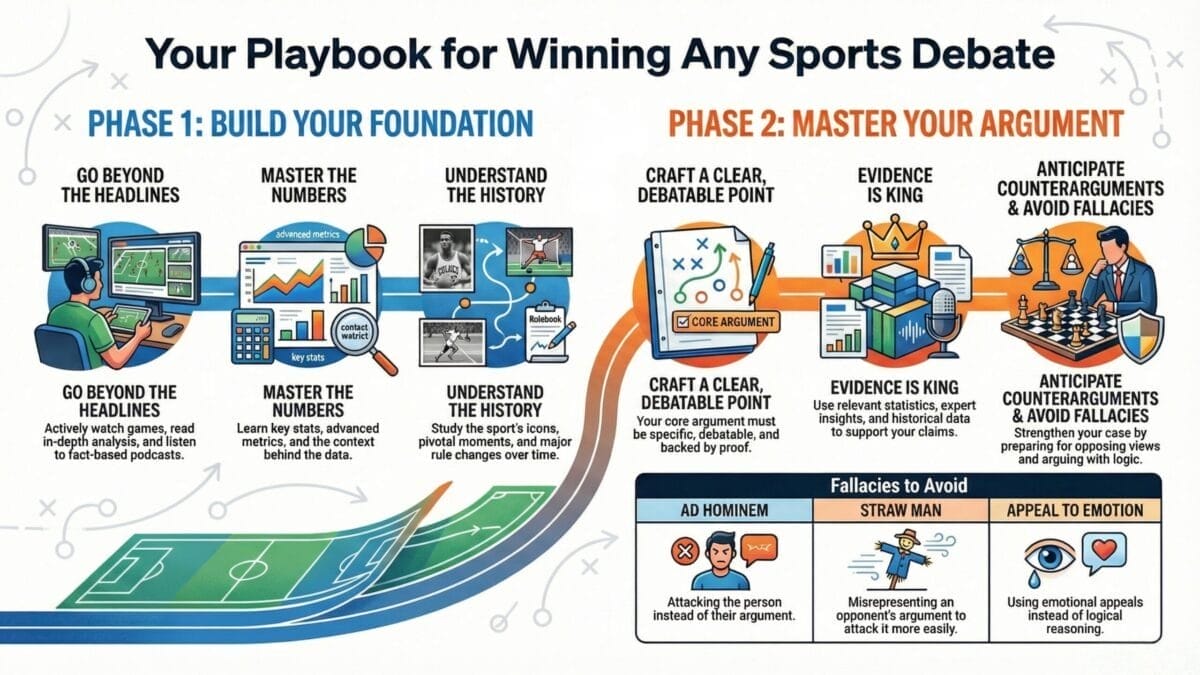 I have one goal: I want you to dominate every single sports argument. I am going to give you the knowledge and skills to confidently win any sports discussion. I will share my research methods, how I spot bias and some of my favorite debate moves. Think of this as your playbook to becoming a sports debate champion.
Building Your Foundation: Knowledge Wins
Knowledge is the base of a great argument. You cannot debate sports well if you do not really understand the game. This means knowing more than the scores. You need to deeply understand the sport you are talking about, its history, the rules and who the main players are.
Watching games every once in a while will not cut it. You have to go find information. This is what I do:
- Watch with focus: See every detail, every team decision and how every player does. Think about what you see instead of just watching.
- Read a lot: Do not just read headlines and scores. Read articles, analysis and historical writings. ESPN and The Athletic are good places to start. Find long stories and books.
- Listen closely: A lot of sports podcasts have smart talk. Find fact based analysis and good arguments, not just the worst takes.
The Power of Numbers: Sports Statistics Are Key
Numbers matter in sports debates. Good stats can help you win. You need to know what the numbers mean and how they connect to what is happening on the field. To debate sports, you need to know stats.
- Learn the main stats: Know the important stats for the sport you follow. If you like basketball, that means points, rebounds, assists, field goal percentage and three point percentage.
- Look past the box score: Learn more advanced stats to better understand players and teams. For basketball, that could be Player Efficiency Rating, Win Shares and Value Over Replacement Player.
- Know the story: Do not just throw out numbers without thinking about what they mean. Think about the era, who they were playing against and anything else that matters.
History Wins: Understand How The Game Changed
Knowing the history makes your arguments better. Knowing how the game changed, its famous people and big moments helps you make better arguments and not make common mistakes.
- Study the icons: Learn about the key players, coaches and leaders. Know what they did and how they changed the game.
- Study the big moments: Know the important games, seasons and events that define the sport. Understand why they matter and how they shaped the game.
- Know the rule changes: Knowing how the rules changed helps you understand the game. It might even help you guess what will happen next.
Crafting Persuasive Arguments: Make Your Case
If you have the right knowledge, you can make good arguments. You must organize your ideas, back them up with proof and think about what others might say.
Every good argument starts with a clear point. This is what you are trying to prove. A good point will be:
- Specific: Do not be general. Be clear about what you are saying.
- Debatable: People should not already agree with you. If they do, there is no debate.
- Backed by proof: You need to have proof to support what you are saying.
For example: LeBron James changed the game more than Michael Jordan because he is a better playmaker and has better stats overall.
A good argument uses logic. Here are some types of logical arguments that I use:
- Deductive reasoning: Start with a big idea and use it in a specific case. For example, all NBA players are athletes. LeBron James is an NBA player. So, LeBron James is an athlete.
- Inductive reasoning: Start with small observations and come to a big conclusion. For example, LeBron James has averaged over 25 points per game for 18 seasons. So, LeBron James is one of the best scorers in NBA history.
- Analogical reasoning: Show how similar situations are related. For example, Tom Brady is the best quarterback because of his Super Bowl wins and how long he played. So, LeBron James should be seen as the best basketball player because of his championships and how well he has played for so long.
Evidence is King: Backing Up Your Claims
Evidence is the most important part of an argument. If you do not have evidence, you are just sharing your opinion. The best evidence is:
- Relevant: The evidence should support what you are saying.
- Accurate: The evidence needs to be correct and something you can prove.
- Substantial: Share enough evidence to win people over.
Here is the evidence that is used in sports debates:
- Statistics: As I said before, stats make your claims stronger.
- Expert insights: Talking about well known analysts, coaches or players can help your argument.
- Personal stories: Sharing stories can show what you mean.
- Historical data: Using historical data to show trends can help your argument.
Anticipating Counterarguments: Making Your Argument Stronger
A strong argument thinks about what others might say. Acknowledge what others think to show that you have thought about all sides. This will make your argument better. Always think about what others might say and have answers ready. Common mistakes to avoid include:
- Straw Man arguments: Changing someone’s argument to make it easier to argue against.
- Ad Hominem attacks: Attacking the person instead of what they are saying.
- Appeals to Emotion: Using emotions instead of logic.
- False Dilemmas: Saying there are only two choices when there are more.
The Art of Persuasion: Communicating Well
The best argument can fail if it is said poorly. Persuasion is important. You must improve how you talk to win debates.

Your voice matters. Speak clearly and at a normal speed. Do not mumble or speak fast. Look people in the eye and show confidence.
Using rhetorical devices can make your arguments better. These are some of my favorites:
- Metaphors: Comparing unrelated things to show your point. For example, Tom Brady is the Mozart of football.
- Similes: Comparing things using “like” or “as”.

Vince Douglas Gregory is the ‘petulant puppet master’ of a sports media landscape addicted to scripted rage and performance art. As the architect of VDG Sports, he bypasses the corporate talking heads to expose the unfiltered truth behind the narratives.
An unstable thinker and astute scholar, Vince thrives on dismantling the mediocre click-bait addicts who trade reality for engagement. If you want boring stats, go elsewhere. If you want the raw reality of the game, you’re in the right place. Consider yourself warned.